
 Book on WhatsApp

Hyundai · Brakes
Hyundai Brake Disc / Rotor in Islamabad & Rawalpindi
We source and deliver the brake disc / rotor for Hyundai vehicles across Islamabad and Rawalpindi — including the Tucson, Elantra, Sonata — as genuine dealer parts, OEM original-equipment parts or quality aftermarket parts. Hyundai parts are supported by a dealer parts network here, with an independent aftermarket that is still thin because the badge has not been on the road long enough to build one, so we confirm the exact variant against your chassis number before ordering and quote a fixed all-in price with delivery to your home or your workshop.
 WhatsApp us
Fitment & genuineness guaranteed
Wrong part? Not the grade we said? We replace it.
Every part is checked against your chassis number before it is ordered, and the grade and brand are stated on your invoice. If a part does not fit the vehicle we confirmed it against, or is not what we said it was, that is our error to carry — read the full guarantee. Delivered across Islamabad & Rawalpindi to your home, office or workshop.
What the brake disc / rotor does
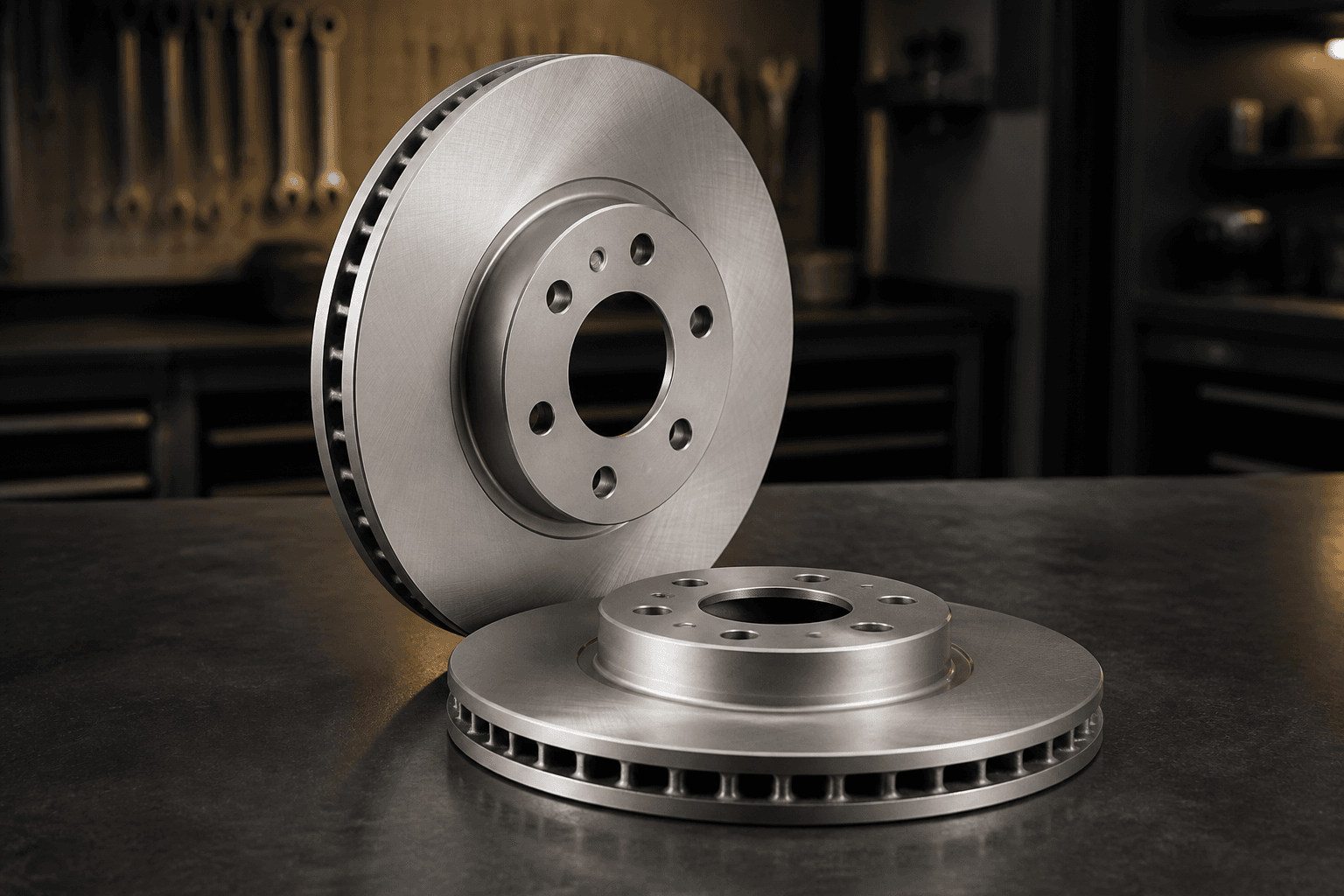
The disc is the heat sink of the braking system. Vented discs have vanes cast between two faces that pump air through the middle as the wheel turns, which is why front discs are usually vented and rear ones often solid. Every disc has a minimum thickness cast or stamped into its hat; below that figure it can no longer absorb the heat of a hard stop safely.
Also called brake rotor, brake disk, disc plate, front brake disc.
Assembled in Pakistan
Sourcing a brake disc / rotor for a Hyundai
Hyundai’s manufacturing presence here is new enough that the parts trade around it is still forming. The dealer counter is properly stocked for current models and the Korean aftermarket is respectable, but there is nothing like the shelf-deep independent supply a Corolla enjoys, so a fair proportion of what we quote comes in on order from Korea or the Gulf rather than from a shop in Rawalpindi. Hyundais that arrived before this generation of assembly are a separate job again, and for those a used-imported original is frequently the sane answer.
The dealer counter is the reliable route on this badge, and quality aftermarket equivalents are arriving as the parc grows. What you cannot yet rely on is walking into an independent shop and finding the part on a shelf, so it is worth asking us before assuming a part is a same-day item.
Availability
Hyundai parts are supported by a dealer parts network here, with an independent aftermarket that is still thin because the badge has not been on the road long enough to build one.
Realistic timing
Routine wear items are usually quick. Anything beyond them is more often ordered in — from the official channel, from Karachi or Lahore, or from abroad — so the honest answer is days rather than hours on a fair share of parts.
Hyundai models we supply this part for
Not listed? The list above is what we are asked for most, not a limit. Send the chassis number and we will tell you whether we can source it.
Diagnose first
Signs your Hyundai needs a new brake disc / rotor
These symptoms are the same on any vehicle — what differs on this badge is how the replacement is sourced, which is covered above.
- steering wheel shakes when braking from motorway speed
- pedal pulses under your foot on a long slow-down
- a raised lip you can feel with a fingernail at the outer edge
- deep circular scoring or grooves across the face
- blue or rainbow discolouration on the disc surface
- rust pitting after the car has stood through monsoon weeks
When is it due?
A disc is finished when it reaches the minimum thickness marked on it, when the face is scored deeply enough to catch a fingernail, or when uneven pad deposits make the car judder under braking. That judder is almost never a bent disc — it is thickness variation from uneven material transfer, and it comes back if you fit new pads to the same disc.
Not sure this is the fault? Brake Warning Signs and What Each One Means — it is cheaper to diagnose properly than to replace the wrong part.
Fitment
What we need to get the right Hyundai brake disc / rotor
This combines what identifies a Hyundai variant with what identifies this specific part. Send these and we can usually confirm in one message.
- the full VIN, which resolves the trim and engine as well as the model
- whether the vehicle was assembled in Pakistan or came in as an import
- engine and fuel type — petrol, diesel or hybrid
- the model variant, because one nameplate here covers more than one build
- photographs of the old part and its connector
- chassis or VIN number, plus the exact trim if the model had a sports or larger-brake version
- outer diameter and thickness measured on the old disc, if it is already off the car
- vented or solid, front or rear
- number of wheel studs and whether the disc bolts to the hub separately
- on the rear: whether the disc has an integral drum for the handbrake
Grades explained
Which grade for a Hyundai brake disc / rotor?
Only the grades that genuinely exist for this part on this badge are shown — the intersection of what is made for a brake disc / rotor and what is obtainable for a Hyundai here.
Genuine (dealer part)
The part sold in the vehicle manufacturer’s own box, through their dealer network — the exact item the car was built with.
- Best for
- Newer vehicles still under warranty, and any safety-critical part you do not want to think about again.
- The trade-off
- The most expensive grade, and for older or imported models it can be slow to arrive or discontinued.
OEM / original-equipment
The same part, made by the same factory that supplies the vehicle manufacturer, sold in that supplier’s own box instead of the carmaker’s.
- Best for
- Almost everyone. Identical engineering to the dealer part, without the carmaker’s box premium.
- The trade-off
- The supplier’s branding differs from the dealer part, so it will not look identical to what you removed.
Aftermarket
A part made by an independent manufacturer to fit your vehicle. Quality ranges from excellent to unusable depending on who made it.
- Best for
- Older vehicles, wear items, and budgets where a genuine part is out of proportion to the car’s value.
- The trade-off
- The brand matters more than the price. We quote named brands so you know exactly what you are buying.
| Grade | What it actually is | Best for | The trade-off |
|---|---|---|---|
| Genuine (dealer part) | The part sold in the vehicle manufacturer’s own box, through their dealer network — the exact item the car was built with. | Newer vehicles still under warranty, and any safety-critical part you do not want to think about again. | The most expensive grade, and for older or imported models it can be slow to arrive or discontinued. |
| OEM / original-equipment | The same part, made by the same factory that supplies the vehicle manufacturer, sold in that supplier’s own box instead of the carmaker’s. | Almost everyone. Identical engineering to the dealer part, without the carmaker’s box premium. | The supplier’s branding differs from the dealer part, so it will not look identical to what you removed. |
| Aftermarket | A part made by an independent manufacturer to fit your vehicle. Quality ranges from excellent to unusable depending on who made it. | Older vehicles, wear items, and budgets where a genuine part is out of proportion to the car’s value. | The brand matters more than the price. We quote named brands so you know exactly what you are buying. |
We tell you which grade we are quoting, and we name the brand. Price depends on the grade and on the exact variant your chassis number resolves to, so it is confirmed on request rather than published here.
Do it once
Worth doing at the same time
These share the labour or the wear cycle. Doing them together means paying the workshop once.
Simple & transparent
How ordering a part works
- 1
Tell us the vehicle and the part
Send the make, model, year and chassis number, plus what you need — or just describe the symptom and a photo of the old part. WhatsApp is fastest.
- 2
We confirm fitment and quote
We identify the exact variant, tell you which grades are available, and quote a fixed all-in price including delivery for each option so you can compare.
- 3
We deliver — home or workshop
You approve the option you want and we deliver to your address or straight to your mechanic, with the guarantee stated in writing on the invoice.
Good to know
Hyundai brake disc / rotor — FAQ
Can my discs be skimmed instead of replaced?
Sometimes, and it is worth asking before you buy. Skimming cuts a fresh flat face and cures a judder, but it also removes metal from a part that has a minimum thickness. If the disc is already close to that figure, skimming leaves it too thin to survive one hard stop down a hill, and the machine work costs a meaningful fraction of a new disc anyway. Measure first, then decide.
My steering shakes when I brake. Are my discs warped?
Almost certainly not, despite what the word gets used for. Cast iron does not bend at road braking temperatures. What happens is that pad material transfers unevenly onto the disc face, so the disc becomes thicker in some places than others and the caliper knocks the pads back once per revolution. You feel that as a shake. It is fixed by a skim or a new disc, and by bedding the new pads in properly.
Do brake discs have to be replaced in pairs?
Yes, per axle. Two discs of different thickness and different surface condition on the same axle brake with different force, which makes the car pull under heavy braking exactly when it should be stable. The parts cost is small next to the risk, and you pay the labour of removing the wheel once either way.
Are drilled or slotted discs a good idea here?
For a road car in Islamabad and Rawalpindi, no. Cross-drilling was designed to vent gases from older pad compounds and it costs the disc some heat capacity and some crack resistance. Modern pads do not need it. On dusty roads the slots also grind pad material away faster. A good plain vented disc with a good pad is the better answer for almost everyone.
Can you source a brake disc / rotor for my Hyundai?
Yes. Hyundai’s manufacturing presence here is new enough that the parts trade around it is still forming. The dealer counter is properly stocked for current models and the Korean aftermarket is respectable, but there is nothing like the shelf-deep independent supply a Corolla enjoys, so a fair proportion of what we quote comes in on order from Korea or the Gulf rather than from a shop in Rawalpindi. Hyundais that arrived before this generation of assembly are a separate job again, and for those a used-imported original is frequently the sane answer. For brakes specifically, routine wear items are usually quick. Anything beyond them is more often ordered in — from the official channel, from Karachi or Lahore, or from abroad — so the honest answer is days rather than hours on a fair share of parts. The dealer counter is the reliable route on this badge, and quality aftermarket equivalents are arriving as the parc grows. What you cannot yet rely on is walking into an independent shop and finding the part on a shelf, so it is worth asking us before assuming a part is a same-day item. Send the chassis number and we will confirm the exact variant and quote a fixed all-in price with delivery before anything is ordered.
Request a Hyundai brake disc / rotor
Send the chassis number and we confirm the exact variant before quoting. Every grade that genuinely exists for this part on a Hyundai gets quoted, with the trade-off stated.
Fitment confirmed before you pay
We check the part against your chassis number, not the badge — one model name covers several different builds.
Every grade quoted side by side
Genuine, OEM, aftermarket and used-imported, with the trade-offs stated, so you choose on facts rather than on a sales pitch.
Fixed all-in price with delivery
One price covering the part and getting it to you — home, office or straight to the workshop holding your car.