
 Book on WhatsApp

Engine & Internal Parts
Connecting Rod in Islamabad & Rawalpindi
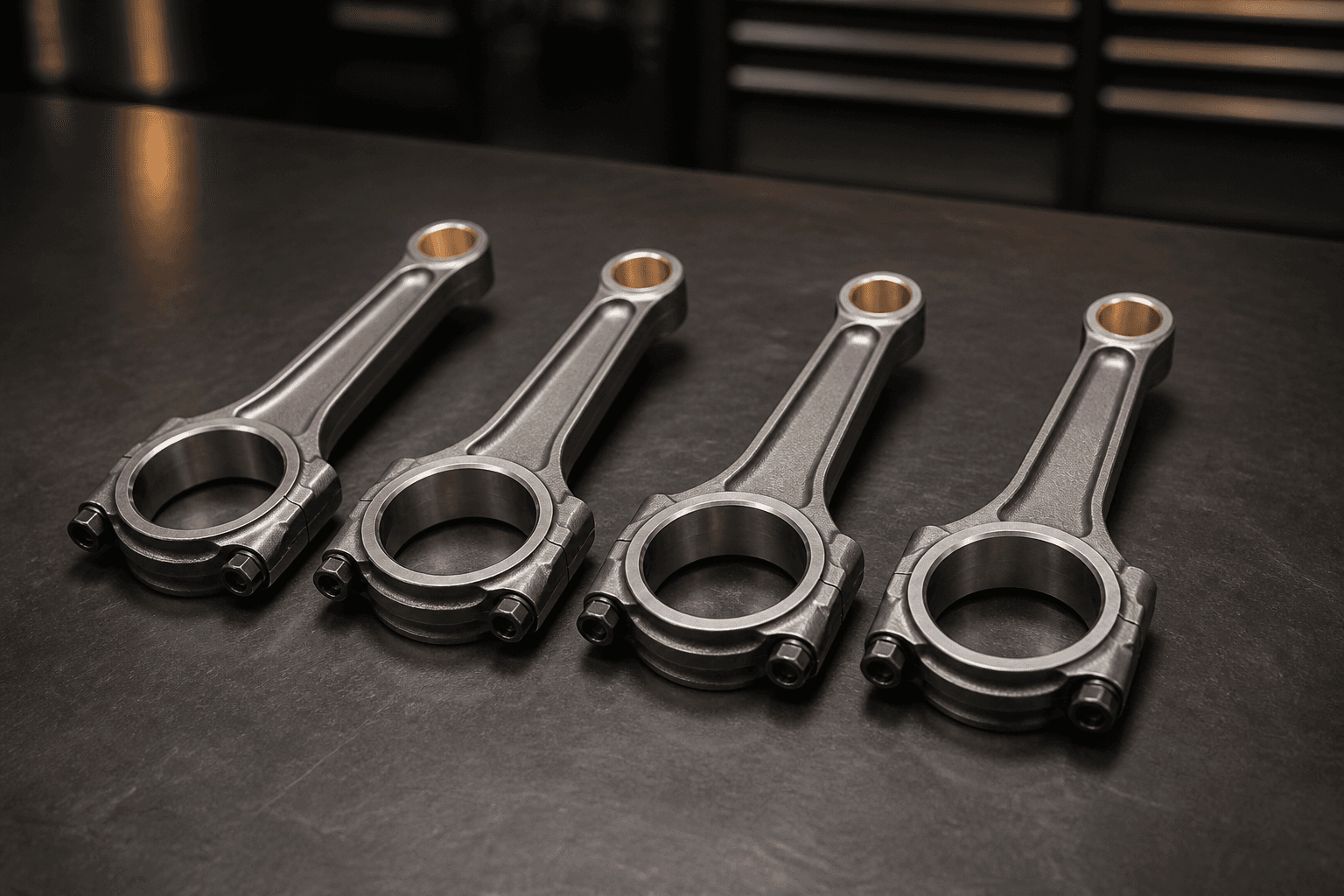
A connecting rod is the forged steel link between a piston and the crankshaft. Its small end carries the gudgeon pin in the piston and its big end clamps around a crank pin on a pair of bearing shells. Rods bend if water is drawn into a cylinder and stretch if the engine is over-revved. We source connecting rods across Islamabad and Rawalpindi.
 WhatsApp us
Fitment & genuineness guaranteed
Wrong part? Not the grade we said? We replace it.
Every part is checked against your chassis number before it is ordered, and the grade and brand are stated on your invoice. If a part does not fit the vehicle we confirmed it against, or is not what we said it was, that is our error to carry — read the full guarantee. Delivered across Islamabad & Rawalpindi to your home, office or workshop.
What the connecting rod does
The connecting rod takes the force of combustion pushing a piston down and delivers it to an offset pin on the crankshaft, turning a straight push into rotation. It also has to pull the piston back up again, and that is the load that stretches rods when an engine is over-revved. Its big end is machined as a matched pair with its own cap, so the two halves are never interchangeable between rods.
Also called con rod, conrod, piston rod, engine rod. If you have been quoted under a different name, it is very likely the same component.
Diagnose first
Signs you need this part
Recognise any of these and the part is worth checking before it takes something more expensive with it.
- engine hydrolocked after driving through standing water
- knocking that got worse very quickly after a bearing failure
- one cylinder low on compression with the valves proven good
- engine will not turn over after being over-revved
- hole punched in the side of the block
- piston sitting lower than its neighbours at top dead centre
When is it due?
Rods do not wear out; they get damaged. In Islamabad and Rawalpindi the most common cause by far is water. Driving into a flooded underpass during monsoon lets water into the intake, and because water does not compress, the rod bends instead of the piston moving. A missed downshift that over-revs the engine and a spun big end that cooks the rod are the other two. The signal is one cylinder low on compression with healthy valves.
Fitment
What we need to get you the right part
The model name is not enough. The same name covers several different builds, and they do not take the same parts — so we work from what actually identifies your vehicle.
- chassis or VIN and the engine code
- centre-to-centre length of the old rod, measured rather than guessed
- gudgeon pin diameter, and whether the pin is a press fit or fully floating
- whether you need a single rod or a matched set for the engine
- photographs of the big end cap showing its stamped position marks
Send these on WhatsApp and we can usually confirm the exact connecting rod for your vehicle in one message rather than three.
Grades explained
Which grade of connecting rod do you need?
Not every grade exists for every part. These are the ones genuinely available for a connecting rod, with the honest trade-off of each.
Genuine (dealer part)
The part sold in the vehicle manufacturer’s own box, through their dealer network — the exact item the car was built with.
- Best for
- Newer vehicles still under warranty, and any safety-critical part you do not want to think about again.
- The trade-off
- The most expensive grade, and for older or imported models it can be slow to arrive or discontinued.
OEM / original-equipment
The same part, made by the same factory that supplies the vehicle manufacturer, sold in that supplier’s own box instead of the carmaker’s.
- Best for
- Almost everyone. Identical engineering to the dealer part, without the carmaker’s box premium.
- The trade-off
- The supplier’s branding differs from the dealer part, so it will not look identical to what you removed.
Aftermarket
A part made by an independent manufacturer to fit your vehicle. Quality ranges from excellent to unusable depending on who made it.
- Best for
- Older vehicles, wear items, and budgets where a genuine part is out of proportion to the car’s value.
- The trade-off
- The brand matters more than the price. We quote named brands so you know exactly what you are buying.
Used / imported (removed)
A working part removed from a low-mileage imported vehicle — the route Pakistan’s market uses for parts that are discontinued or absurdly expensive new.
- Best for
- Body panels, lights, interior trim, gearboxes and engines for imported and out-of-production models.
- The trade-off
- Condition varies. We photograph the actual item before you commit, and it carries a shorter guarantee.
| Grade | What it actually is | Best for | The trade-off |
|---|---|---|---|
| Genuine (dealer part) | The part sold in the vehicle manufacturer’s own box, through their dealer network — the exact item the car was built with. | Newer vehicles still under warranty, and any safety-critical part you do not want to think about again. | The most expensive grade, and for older or imported models it can be slow to arrive or discontinued. |
| OEM / original-equipment | The same part, made by the same factory that supplies the vehicle manufacturer, sold in that supplier’s own box instead of the carmaker’s. | Almost everyone. Identical engineering to the dealer part, without the carmaker’s box premium. | The supplier’s branding differs from the dealer part, so it will not look identical to what you removed. |
| Aftermarket | A part made by an independent manufacturer to fit your vehicle. Quality ranges from excellent to unusable depending on who made it. | Older vehicles, wear items, and budgets where a genuine part is out of proportion to the car’s value. | The brand matters more than the price. We quote named brands so you know exactly what you are buying. |
| Used / imported (removed) | A working part removed from a low-mileage imported vehicle — the route Pakistan’s market uses for parts that are discontinued or absurdly expensive new. | Body panels, lights, interior trim, gearboxes and engines for imported and out-of-production models. | Condition varies. We photograph the actual item before you commit, and it carries a shorter guarantee. |
We tell you which grade we are quoting, and we name the brand. Price depends on the grade and on the exact variant your chassis number resolves to, so it is confirmed on request rather than published here.
Do it once
Worth replacing at the same time
Not an upsell — these share the labour or the wear cycle with the part you came for. Doing them together means paying the workshop once instead of twice.
- Engine Bearing SetMain and connecting rod bearing shells — the soft metal layer the crankshaft actually spins on, and the source of engine knock.
- Piston Ring SetThe rings that seal combustion and control oil on the cylinder wall — the part behind blue smoke and rising oil use.
- Full Gasket KitEvery gasket, seal and O-ring the engine uses, in one box — the set you order when the engine is already open.
Fits
Vehicles this part is fitted to
Simple & transparent
How ordering a part works
- 1
Tell us the vehicle and the part
Send the make, model, year and chassis number, plus what you need — or just describe the symptom and a photo of the old part. WhatsApp is fastest.
- 2
We confirm fitment and quote
We identify the exact variant, tell you which grades are available, and quote a fixed all-in price including delivery for each option so you can compare.
- 3
We deliver — home or workshop
You approve the option you want and we deliver to your address or straight to your mechanic, with the guarantee stated in writing on the invoice.
Good to know
Connecting Rod — FAQ
Can a bent connecting rod be straightened?
We would advise against it, even though it is offered here. Straightening puts the rod back near its original shape but leaves the steel worked and the big end bore no longer round, and that bore is what holds your bearing shell still and fed with oil. The rod may run for a while and then let go at speed, taking the block with it. Replace bent rods and have the remaining ones checked for stretch.
My car went through standing water and stopped. What should I do first?
Do not try to start it again. That is the moment most engines are destroyed, rather than the moment they got wet. Have the plugs removed and the engine turned over by hand so any water in the cylinders is pushed out, then have the oil checked for water before it is run. Handled quickly, a hydrolocked engine sometimes escapes with nothing bent. Cranked repeatedly, it becomes a rod job.
Do I have to replace all the rods or just the damaged one?
Usually just the damaged one, provided the others measure straight and their big end bores are round. Rods are weight-matched from the factory within a tolerance, and a single correct replacement stays inside it. Where the engine has been over-revved hard, ask the machinist to check every rod for stretch — the one that failed is often the only one that showed it, not the only one that suffered.
Do you supply rods with the bearing shells?
They are quoted separately, because which shells you need depends on whether your crankshaft is standard or has been ground undersize, and only the machinist’s measurement settles that. We ask for the journal size before quoting shells so you do not end up with a rod fitted on clearances nobody checked. Rod, shells and the gasket set for the job are all confirmed on request.
Request a connecting rod
Tell us the vehicle and we confirm the exact fitment against your chassis number before quoting. Every grade that genuinely exists for this part gets quoted, with the trade-off stated.
Fitment confirmed before you pay
We check the part against your chassis number, not the badge — one model name covers several different builds.
Every grade quoted side by side
Genuine, OEM, aftermarket and used-imported, with the trade-offs stated, so you choose on facts rather than on a sales pitch.
Fixed all-in price with delivery
One price covering the part and getting it to you — home, office or straight to the workshop holding your car.